Abstract
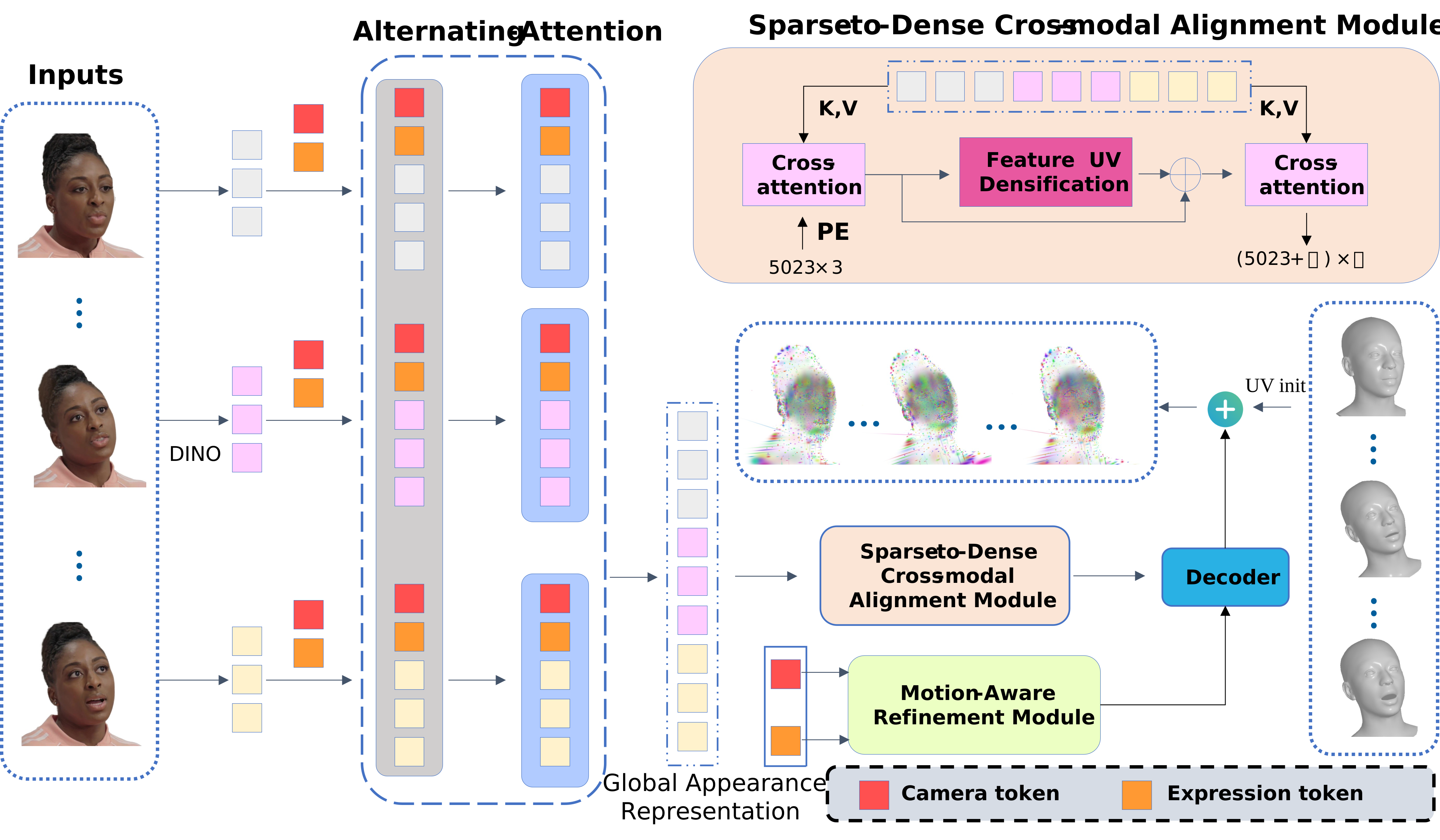
We present FFAvatar, a Transformer-based 3D Gaussian framework for fast construction of high-quality and animatable 4D head avatars from one or more reference portrait images. Unlike existing feed-forward approaches that require a fixed number of input views, FFAvatar supports incremental reconstruction, progressively refining the avatar representation as additional reference images become available.
At the core of our method is an alternating attention mechanism that disentangles identity appearance from expression and viewpoint variations, enabling the reconstruction of a canonical 3D appearance that remains consistent across poses and facial expressions. To balance visual fidelity and computational efficiency, we introduce a sparse-to-dense learning paradigm. Coarse appearance features are first learned using sparse primitives anchored to the FLAME vertex level and are subsequently densified in the UV domain to capture fine-grained geometric and texture details.
We further propose a plug-and-play motion refinement module that enables subject-specific dynamic personalization by modeling residual motion beyond parametric deformation. Extensive experiments demonstrate that FFAvatar efficiently produces high-fidelity and controllable 4D head avatars, achieving superior flexibility, driving efficiency, and identity-consistent rendering across diverse expressions and viewpoints.
Method
Video
Citation
@inproceedings{yao2026ffavatar,
  title     = {FFAvatar: Feed-Forward 4D Head Avatar Reconstruction from Sparse Portrait Images},
  author    = {Jianjiang Yao and Ke Xian and Renxiang Dai and Robert Caiming Qiu},
  booktitle = {European Conference on Computer Vision},
  year      = {2026}
}